Rethinking Nepal’s Fixed Exchange Rate with the Indian Rupee
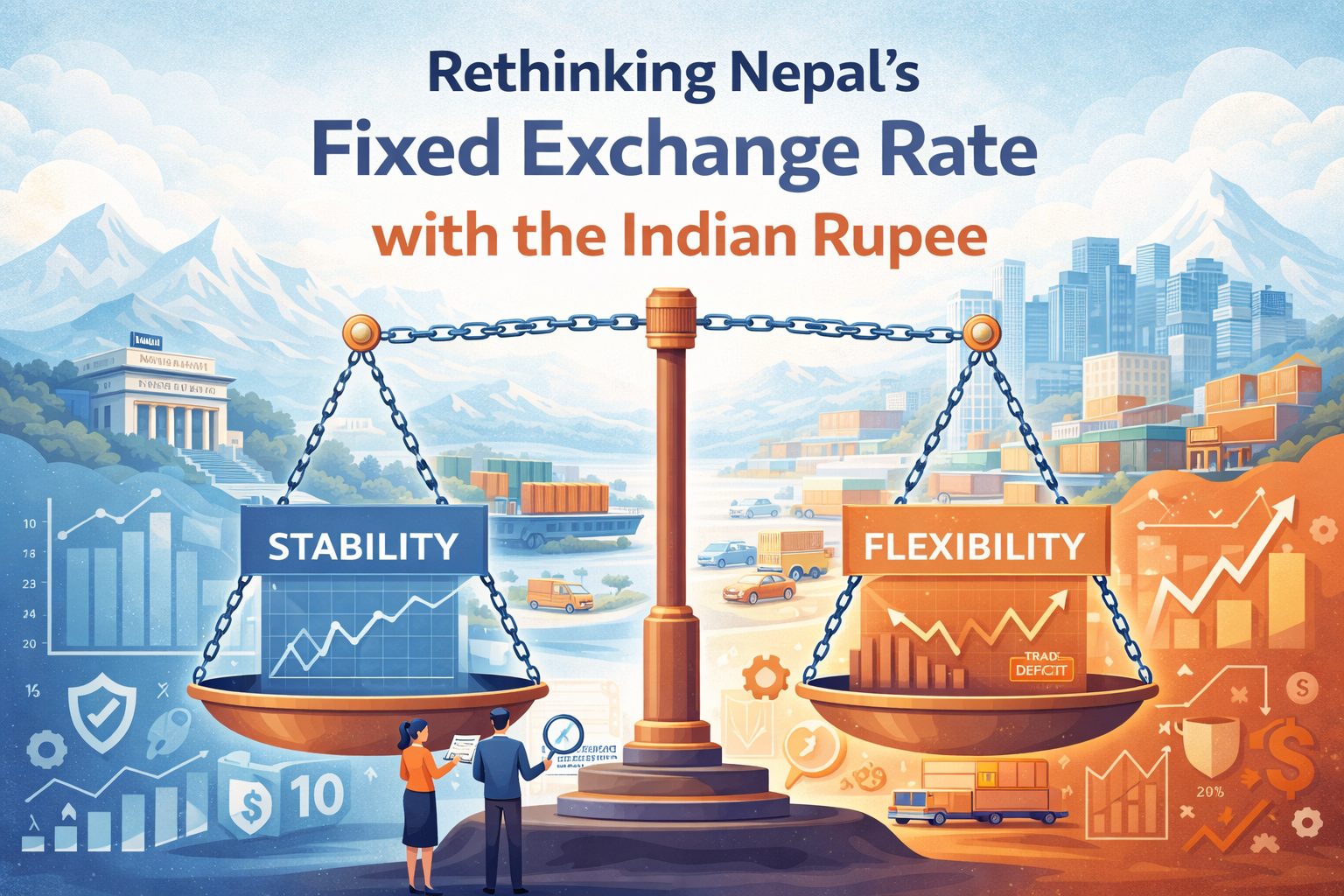

Every election cycle in Nepal brings a familiar wave of economic debate. Discussions around development, employment, inflation, investment, and governance begin to dominate public attention. This time, however, a more technical yet highly significant issue has come to the forefront whether Nepal should continue its long-standing fixed exchange rate system with the Indian Rupee or reconsider it in light of changing economic realities.
For more than three decades, Nepal has maintained a fixed exchange rate of 1 Indian Rupee equal to 1.6 Nepali Rupees. This arrangement has provided stability, predictability, and simplicity in trade and monetary management. It has helped businesses plan with confidence and has contributed to overall macroeconomic stability. Yet today, the debate is far from settled. Economists, policymakers, and business leaders remain divided. Some argue that the peg has become a barrier to economic growth, while others view it as a vital anchor that continues to support the economy.
Understanding the Fixed Exchange Rate System
A fixed exchange rate system, often referred to as a currency peg, is more than just a technical policy choice. It is a strategic decision about how a country positions its economy in relation to another. Under this system, a nation links the value of its currency to a foreign currency at a predetermined rate and actively maintains that rate through its central bank. In Nepal’s case, the Nepali Rupee is pegged to the Indian Rupee, creating a stable and predictable monetary relationship between the two economies.
At first glance, the logic behind such a system appears straightforward. Stability in exchange rates reduces uncertainty. For a country like Nepal, where a large share of trade takes place with India, this stability plays a crucial role in everyday economic life. Importers know exactly how much they will pay for goods. Exporters can price their products without worrying about sudden currency fluctuations. Even ordinary consumers indirectly benefit, as price volatility in essential goods is kept under control.
This predictability also builds confidence. Investors, both domestic and foreign, are more willing to commit capital when they are assured that currency risks are minimal. In economies where financial markets are still developing, such confidence can be just as important as capital itself. In this sense, a fixed exchange rate acts like an anchor, holding the economy steady in an otherwise uncertain global environment.
But this stability is not without trade-offs. By tying its currency to another, a country gives up a significant degree of control over its own monetary policy. Nepal cannot fully decide its interest rates, money supply, or inflation strategy independently. Instead, it must often align with the economic conditions and policy decisions of India. If India tightens its monetary policy or experiences inflation, Nepal feels the ripple effects, whether or not those changes reflect Nepal’s domestic needs.
In a deeper sense, a fixed exchange rate is a balance between control and certainty. It offers stability and simplicity, but at the cost of flexibility. For countries with strong and diversified economies, flexibility can be a powerful tool. For countries still building their economic base, however, stability can sometimes be more valuable. Nepal’s long-standing reliance on this system reflects this delicate balance between the need for economic security and the desire for policy independence.
The Historical Journey of Nepal’s Currency Peg
In the early years, Nepal’s monetary environment was fragmented and unregulated. Indian currency circulated widely, especially in the Terai region, and exchange rates varied from one marketplace to another. Traders, money changers, and local actors often set their own rates, creating confusion, inefficiency, and opportunities for arbitrage. In such a setting, maintaining economic discipline and monetary sovereignty was extremely difficult.
To bring order to this situation, the government took a decisive step. With the establishment of Nepal Rastra Bank and the introduction of foreign exchange regulations, the country began to formalize its monetary system. Fixing the exchange rate between the Nepali Rupee and the Indian Rupee was not just about stabilizing currency values for building trust in the Nepali currency itself and ensuring uniformity across the economy.
Over time, the exchange rate was adjusted multiple times to reflect changing economic realities. These adjustments were not random decisions but responses to shifts in trade dynamics, inflation, external pressures, and domestic economic needs. Each revision tells a story of how Nepal tried to balance stability with competitiveness.
Historical Exchange Rate Adjustments INR 100 to NPR
|
Date |
Exchange Rate |
|
Baisakh 1, 2017 |
160 |
|
Jestha 24, 2023 |
101 |
|
Mangsir 22, 2024 |
135 |
|
Poush 7, 2028 |
139 |
|
Chaitra 10, 2034 |
145 |
|
Mangsir 15, 2042 |
170 |
|
Jestha 17, 2043 |
168 |
|
Asar 20, 2048 |
165 |
|
Falgun 2, 2049 |
160 |
Looking at this progression, one can observe that Nepal did not always follow a rigid path. The exchange rate moved both upward and downward depending on the economic context of the time. At certain points, the Nepali Rupee was strengthened, while at others, it was deliberately weakened to respond to external imbalances or domestic pressures.
However, since Falgun 2, 2049, the exchange rate has remained unchanged at 160 Nepali Rupees for 100 Indian Rupees. This remarkable consistency over more than three decades is rare in the global economic landscape. For many countries, exchange rates fluctuate frequently, driven by market forces and policy shifts. Nepal’s ability to maintain such stability reflects both disciplined monetary management and the unique nature of its economic relationship with India.
Yet, this long period of stability is a double-edged sword. On one hand, it has provided predictability, reduced transaction risks, and supported trade integration. On the other hand, it raises an important question, Has the economy evolved while the exchange rate has remained unchanged?
Why the Peg Worked for Nepal
Nepal’s fixed exchange rate has worked largely because of its strong economic ties with India. A major share of Nepal’s trade is with India, and the open border allows easy movement of goods, services, and labor. In such a setup, a stable exchange rate reduces uncertainty for businesses and supports smooth trade.
Importers can predict costs, exporters can set prices confidently, and consumers benefit from relatively stable prices. The peg has also helped control inflation, as Nepal indirectly follows India’s relatively stable price trends.
At the same time, it has simplified monetary management. Instead of dealing with constant currency fluctuations, the central bank can focus on maintaining reserves and liquidity.
Overall, the peg has worked as a stabilizing anchor for Nepal’s economy, matching its structure and dependency on India.
The Hidden Costs of Pegging
While stability sounds appealing, it often hides deeper structural challenges.
One major issue is the loss of monetary independence. Nepal cannot freely adjust its interest rates or money supply without considering India’s policies. If India tightens its monetary policy, Nepal feels the impact regardless of its domestic needs.
Another critical issue is overvaluation. Many economists argue that the Nepali Rupee has become overvalued against other global currencies because it is tied to the Indian Rupee. This makes Nepali exports less competitive in international markets.
The result is visible in Nepal’s persistent trade deficit. Imports continue to rise, while exports struggle to grow.
The Marshall Lerner Condition of Economics
To understand whether changing the exchange rate can actually improve Nepal’s trade balance, economists often use a concept called the Marshall Lerner condition.
At its core, the idea is simple. If a country weakens its currency, exports become cheaper for foreign buyers and imports become more expensive for domestic consumers. In theory, this should help reduce the trade deficit. But this only works under one important condition where people must respond strongly to these price changes.
In other words, when prices change, exports should increase a lot and imports should decrease noticeably. Economists call this responsiveness “price elasticity.” If both exports and imports are sensitive to price changes, then devaluation can improve the trade balance.
In Nepal’s case, this condition is hard to meet. Most of Nepal’s imports are essential goods like fuel, medicines, machinery, and raw materials. Even if these become expensive, the country cannot easily reduce their use. People and businesses still need them, so imports do not fall much.
On the other hand, Nepal’s exports are limited and not highly diversified. Even if Nepali goods become cheaper in international markets, the country does not have enough production capacity to quickly increase exports.
Because of this, weakening the currency may not solve the trade deficit. Instead, it could make imports more expensive without significantly increasing exports. This means higher costs for businesses and consumers, without a strong improvement in trade balance.
Need for Change
Despite these challenges, many economists believe that the time has come to rethink the fixed exchange rate system.
One argument is that Nepal’s economy has changed significantly since 2047. Trade is no longer limited to India. Nepal now engages with China, the United States, the European Union, and other countries.
A fixed peg to a single currency may no longer reflect this diversified trade pattern.
Another concern is interest rate instability. Some experts argue that the peg forces adjustments through interest rates rather than exchange rates. This leads to sudden increases in borrowing costs, discouraging long-term investment.
There is also the issue of economic dependency. By tying its currency to India, Nepal indirectly imports India’s economic fluctuations. This limits Nepal’s ability to respond independently to global shocks.
Why the Peg Should Not Be Revised or Changed?
On the other side of the debate, many economists and policymakers advise caution. Their argument is not that change is unnecessary, but that Nepal may not yet be ready for such a major shift.
Nepal’s economy is still developing. The industrial base is limited, exports are weak, and the financial system is not strong enough to handle sudden shocks. In such a situation, the fixed exchange rate acts like a safety net, providing stability in an otherwise uncertain environment.
If the peg is removed or significantly changed, the currency could start fluctuating unpredictably. This would directly affect import prices, making essential goods like fuel, medicine, and food more expensive. As a result, inflation could rise quickly, increasing the cost of living for ordinary people.
Businesses would also face uncertainty. When exchange rates move up and down frequently, planning becomes difficult. Importers may face higher costs, exporters may struggle with pricing, and investors may delay decisions due to risk. This can slow down economic activity instead of supporting growth.
Another major concern is speculative attacks. If the currency is made flexible without strong financial institutions and enough foreign reserves, traders and investors might try to profit from sudden changes in value. This can cause rapid depreciation and instability, which is difficult to control.
For a country like Nepal, where the economy is still fragile and highly dependent on imports, such instability could have serious consequences. That is why many experts believe that maintaining the current peg, at least for now, is a safer and more practical approach.
Potential Impacts of Changing the Peg
Changing the exchange rate system is not a simple decision. It can bring both opportunities and risks, and the final impact depends on how strong the economy is and how the change is managed.
Positive Impacts
A more flexible exchange rate could make Nepali goods cheaper in international markets. This may help exports grow, as foreign buyers would find Nepali products more affordable. Over time, this could improve Nepal’s trade balance.
It would also give Nepal more control over its own monetary policy. The central bank could set interest rates based on Nepal’s economic needs rather than indirectly following India. This flexibility can help manage inflation, investment, and economic growth more effectively.
Another advantage is that a flexible exchange rate can act like a shock absorber. During global or regional economic crises, the currency can adjust on its own. This adjustment can reduce pressure on the economy and help maintain balance without drastic policy changes.
Negative Impacts
At the same time, the risks are significant and immediate.
Nepal depends heavily on imports, especially for essential goods. If the currency weakens, imports become more expensive. This can quickly increase inflation and raise the cost of living for people.
Industries in Nepal rely on imported raw materials and machinery. When these inputs become expensive, production costs rise. This reduces profits for businesses and can slow down overall economic activity.
There is also the issue of uncertainty. A flexible exchange rate means the currency value can change frequently. This makes it harder for businesses to plan, invest, and manage risks. As a result, investors may become cautious and delay long-term decisions.
In simple terms, while changing the peg can create new opportunities, it also brings serious risks. Without a strong economic foundation, the negative impacts may be felt more quickly than the positive ones.
How Revise can be Done Safely
If Nepal decides to revise its exchange rate system, the most important principle is simple, it should not be done suddenly. A rushed decision can create instability, but a gradual and well-planned approach can reduce risks and build confidence.
Most experts suggest a step-by-step transition.
In the first stage, Nepal should continue with the current peg while focusing on strengthening the economy. This means improving exports, expanding industries, reducing import dependency, and making the financial system more stable. At the same time, detailed research and policy preparation should be carried out so that decisions are based on real data, not assumptions.
In the second stage, Nepal can move toward a managed system. Here, the exchange rate is allowed to adjust within a controlled range. The central bank still plays an active role by intervening when needed to prevent large or sudden fluctuations. This stage helps the economy slowly adjust to flexibility without facing major shocks.
In the final stage, Nepal can consider moving toward a fully market-based exchange rate system. In this system, the value of the currency is determined by demand and supply in the market. However, this step should only be taken when the economy is strong, exports are competitive, and financial institutions are capable of handling volatility.
In simple terms, safe reform is not about changing the system overnight. It is about preparing the economy, moving gradually, and ensuring stability at every step.
Voices from Different Perspectives
The debate on Nepal’s exchange rate peg includes diverse opinions from economists, policymakers, and business leaders, each interpreting its impact through different economic priorities.
Some economists, such as Dr. Yubaraj Khatiwada, argue that the current peg may have led to an overvalued Nepali Rupee in real terms. From this perspective, the overvaluation reduces export competitiveness while making imports cheaper, which can contribute to a growing trade deficit over time.
Similarly, economists like Rameshwor Khanal and Nar Bahadur Thapa have highlighted the need for careful reassessment of Nepal’s exchange rate regime. They point out that while the peg has supported stability, it may also be limiting external sector flexibility and masking underlying structural weaknesses in exports and productivity.
Business communities also hold mixed views depending on their exposure. Import-dependent traders generally support the peg because it provides price certainty and reduces currency risk. Export-oriented businesses, however, often favor greater flexibility, arguing that a more competitive exchange rate could improve Nepal’s export performance.
In the middle, many policy analysts suggest a balanced approach. Rather than abandoning the peg entirely, they recommend periodic review and gradual adjustment to ensure the rate reflects evolving economic conditions.
Overall, the debate is not about a simple yes or no, but about finding the right balance between stability, competitiveness, and long-term economic resilience.
The Way Forward
Nepal stands at an important economic crossroads. The fixed exchange rate system has served the country well in the past. It has provided stability, supported trade, and anchored inflation. But the world has changed.
Nepal’s economic relationships are evolving, and new challenges are emerging. The question is not whether the peg is good or bad. The real question is whether it remains suitable for Nepal’s future.
A careful, evidence-based approach is needed. Policymakers must balance stability with flexibility, short-term risks with long-term gains.
Conclusion
The debate over Nepal’s fixed exchange rate with the Indian Rupee is ultimately about more than currency policy, it reflects the country’s broader search for a clear and sustainable economic direction.
Stability has played a crucial role in maintaining confidence, controlling inflation, and supporting trade over the years. However, stability should not come at the cost of long-term economic dynamism and growth. At the same time, any move toward change must be handled with careful planning, as sudden shifts could create unnecessary risks for a still-developing economy.
The most realistic path forward is not found in extreme choices, but in gradual and well-managed reform. Strengthening economic fundamentals, improving industrial capacity, expanding exports, and building stronger financial institutions will matter far more than any immediate policy shift.
In the long run, the exchange rate is only one instrument among many. Nepal’s economic future will be shaped more by how effectively it builds productive industries, enhances competitiveness, and creates sustainable opportunities for its people.